
Next.js: Modern Web Applications for Sustainable Business Success
What is Next.js?
Next.js is a React-based full-stack framework developed by Vercel that has revolutionized the creation of modern web applications. As a production-ready framework, it extends React with essential features like Server-Side Rendering (SSR), Static Site Generation (SSG), automatic code splitting, and integrated performance optimizations.
At Ventura, we've been using Next.js since 2017 and first deployed it in production in 2018 – a decision that has proven itself in countless successful projects. This extensive experience enables us to optimally leverage the framework's strengths for our clients and identify and solve potential challenges early on.
At its core, Next.js solves the fundamental challenges of modern web development: It combines the flexibility of React with the performance of static websites and the dynamism of server-rendered applications. Developers no longer have to choose between SEO-friendliness, performance, and developer experience – Next.js delivers all three aspects in a coherent framework.
The Advantages of Next.js
Faster Time-to-Market
The extensive built-in features of Next.js significantly reduce development time. Routing, bundling, code splitting, and optimizations are already integrated, allowing development teams to focus on business logic. Our experience shows: Projects that would traditionally take 12-16 weeks can often be realized with Next.js in 6-8 weeks – without compromising quality.
"Bring Your Own Data" - Flexibility Through API-Agnostic Architecture
A key aspect of Next.js is complete flexibility in data connectivity. The framework doesn't dictate which backend systems or APIs you must use. This architectural philosophy fits perfectly with our focus on composable platforms.
Next.js integrates seamlessly with any data source: REST APIs, GraphQL endpoints, traditional databases, headless CMS systems, or modern cloud services. Data connectivity happens through flexible data fetching methods that work both at build time and runtime.
This independence means concretely: You can keep your existing backend infrastructure and still benefit from modern frontend technologies. Whether you work with Commercetools, Contentful, your own REST API, or GraphQL services – Next.js grows with your system landscape.
For companies pursuing a composable commerce strategy, this flexibility is crucial. You can combine best-of-breed services without being limited by frontend constraints. Next.js acts as a universal presentation layer for your modular architecture.

Superior Performance as Competitive Advantage
Google's Core Web Vitals are now crucial for rankings and user experience. Next.js applications consistently achieve top scores in:
- Largest Contentful Paint (LCP): Through intelligent preloading and optimized image delivery
- First Input Delay (FID): Minimal JavaScript overhead through automatic code splitting
- Cumulative Layout Shift (CLS): Stability through server-side rendering
These performance advantages translate directly into measurable business results: higher conversion rates, lower bounce rates, and better SEO rankings.
Developer Productivity and Talent Acquisition
The excellent developer experience of Next.js is an often underestimated business advantage. Features like Fast Refresh, TypeScript support, and integrated development tools not only increase the productivity of existing teams but also facilitate recruiting qualified developers. Next.js is among the most sought-after skills in the frontend space – an advantage in talent acquisition.
Use Cases and Application Areas
E-Commerce Storefronts: Performance Meets Conversion
Modern e-commerce storefronts require lightning-fast loading times, excellent SEO, and dynamic personalization. Next.js optimally meets these requirements:
- Product pages are statically generated and delivered via CDNs
- Shopping carts and checkout use dynamic server-side rendering
- Personalization happens through Edge Functions without performance penalties
When implementing headless commerce solutions with Commercetools or Shopify, we've consistently achieved loading times under 2 seconds with Next.js – a crucial factor for conversion rates in e-commerce.

Digital Experience Platforms: Security and Speed Combined
Digital experience platforms such as customer portals have special requirements for authentication, data protection, and performance. Next.js offers:
- API Routes for secure backend logic directly in the framework
- Middleware for granular access control
- Incremental Static Regeneration (ISR) for personalized dashboards
The ability to keep sensitive business logic server-side while the UI remains reactive and fast makes Next.js the ideal choice for B2B portals and customer platforms.
Content Sites and News Platforms: SEO Excellence
For publishers and media companies, SEO is business-critical. Next.js offers:
- Integrated, granular metadata management
- Structured data and Schema.org integration
- Automatic sitemap generation
- Open Graph and Twitter Card rendering
The combination of static generation for articles and dynamic elements for comments and live updates makes Next.js the perfect choice for modern publishing platforms.

E-Commerce Ecosystems: Composable Architecture
In the context of MACH architectures (Microservices, API-first, Cloud-native, Headless), Next.js serves as the ideal frontend layer:
- API integration with any backend services
- Edge Functions for geo-localization and A/B testing
- Multi-tenant architectures for marketplaces and platforms
Technical Excellence in Detail
App Router and React Server Components: The Future of React Routing
The App Router in Next.js 13 was a paradigm shift. React Server Components enabled us to develop applications that are both highly performant and developer-friendly. The co-location of layouts, loading states, and error boundaries revolutionized our development speed.
Today, with Next.js 16, we use features like:
- React Server Components for optimal performance
- Streaming SSR for progressive page rendering
- Turbopack for lightning-fast development cycles
- Partial Prerendering for hybrid rendering strategies
Rendering Strategies for Every Use Case
Next.js offers flexible rendering options:
- Static Site Generation (SSG): For content that rarely changes
- Server-Side Rendering (SSR): For personalized or highly dynamic content
- Incremental Static Regeneration (ISR): The best of both worlds
- Client-Side Rendering (CSR): For interactive dashboard areas
The ability to mix these strategies at the route level enables optimal performance for each page type.
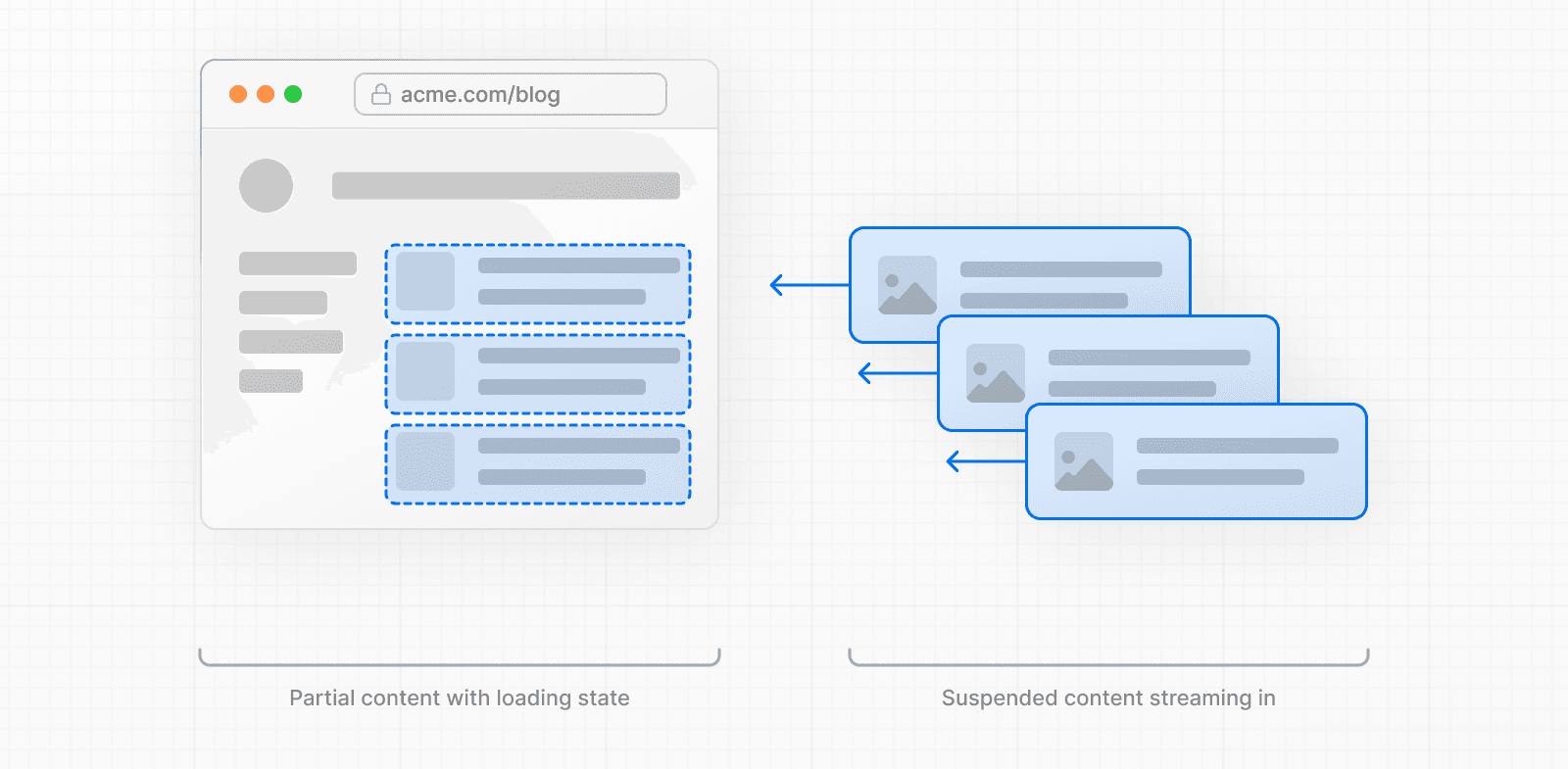
Performance Optimization Out-of-the-Box
Next.js automates numerous performance optimizations:
- Automatic code splitting loads only necessary code
- Prefetching of links in the viewport
- Font optimization eliminates layout shifts
- Image optimization with automatic format conversion (WebP, AVIF)
- Script optimization for third-party integrations
These optimizations happen almost automatically, without additional configuration – a significant productivity advantage.
Integration into Modern Tech Stacks
Headless CMS Integration
Next.js harmonizes perfectly with modern headless CMS solutions:
- Contentful: For enterprise content management
- Payload CMS: Open-source CMS with TypeScript-first approach
- Strapi: Flexible, self-hosted CMS
- Sanity: Real-time collaboration for content teams
Next.js's preview functionality enables content editors to see changes before publication – a crucial workflow advantage.
Composable Commerce Architectures
In the e-commerce space, Next.js integrates seamlessly with:
- Commercetools: For enterprise composable commerce
- Shopify and Shopify Plus: Headless commerce storefronts
These integrations make it possible to combine best-of-breed solutions while delivering a consistent, performant user experience.
Our Expertise: From Theory to Practice
Early Adoption, Continuous Innovation
Since our first Next.js implementation in 2017, we've witnessed and shaped the framework's evolution firsthand. This experience means:
- Proven architecture patterns from dozens of projects
- Knowledge of typical pitfalls and how to avoid them
- Optimized development workflows for maximum efficiency
- Deep-dive expertise in performance optimization and scaling
Successful Implementations
In our Next.js projects, we've consistently achieved impressive results:
- 60% reduction in loading times compared to traditional SPA approaches
- 40% higher conversion rates through improved Core Web Vitals
- 50% faster development cycles through optimized workflows
- 80% cost savings in hosting through efficient caching strategies
Best Practices from Practice
Our years of experience have led to a robust set of best practices:
Architecture Decisions:
- Clear separation of server and client components
- Strategic use of ISR for optimal cache invalidation
- Middleware for cross-cutting concerns like authentication
Performance Optimization:
- Lazy loading of heavy components
- Optimistic UI updates for better perceived performance
- Strategic preloading based on user intent
Development Workflow:
- TypeScript-first for type safety
- Comprehensive testing with Playwright and Jest
- Automated performance audits in CI/CD
Challenges and Solution Approaches
Complexity in Large Applications
With growing application size, complexity can increase. Our solution approaches:
- Modularization through feature-based architecture
- Monorepo strategies with Turborepo or Nx
- Strict TypeScript for maintainability
- Comprehensive documentation and architecture decision records
SEO in Dynamic Applications
While SSG offers excellent SEO, dynamic content requires special attention:
- Strategic ISR for frequently updated content
- Dynamic sitemaps for large content volumes
- Structured data for rich snippets
- Core Web Vitals monitoring for continuous optimization
Future-Proofing and Evolution
Next.js 15 and Beyond
The development of Next.js and React continues to progress:
- Server Actions for simplified form handling
- Partial Prerendering for optimal performance
- Enhanced Turbopack for even faster builds
AI Integration and Modern Workflows
Next.js and Vercel position themselves as the ideal platform for AI-powered applications:
- Vercel AI SDK integration for LLM features
- Vercel Edge Functions for low-latency AI inference
- Streaming responses for ChatGPT-like interfaces
Implementation
We understand Next.js not just as a framework, but as a strategic business tool:
- Discovery Phase: Analysis of your business goals and technical requirements
- Architecture Design: Tailored solution based on best practices
- Rapid Prototyping: Early validation of concepts
- Iterative Development: Agile implementation with continuous feedback
- Performance Optimization: Fine-tuning for optimal results and the best user experience
- Operations: We handle complete platform operations and support on request, so you can save important resources
- Knowledge Transfer: Sharing is caring: We train your team to further develop the platform
Composable Architecture Expertise
As specialists in composable architecture, we use Next.js as the central frontend layer in MACH architectures:
- API-first design for maximum flexibility
- Microservices integration for scalability
- Cloud-native deployment for cost efficiency
- Headless approaches for omnichannel experiences
Conclusion: Next.js as Strategic Enabler
Next.js has evolved from a React framework to a complete platform for modern web applications. The combination of developer experience, performance optimization, and production readiness makes it the first choice for business-critical applications.
We've accompanied the evolution of Next.js since 2017 and successfully deployed it in numerous projects. This experience, combined with our understanding of business requirements and technical excellence, enables us to optimally apply Next.js to your specific challenges.
The decision for Next.js is more than a technical choice – it's an investment in future-proofing, performance, and development efficiency. In a digital landscape where user experience and speed determine success, Next.js provides the tools and capabilities to not just keep up, but outperform the competition.
Whether e-commerce storefront, customer portal, content platform, or innovative AI application – Next.js offers the flexibility and capability to realize your digital ambitions. With the right expertise and strategic approach, Next.js becomes the catalyst for digital success.